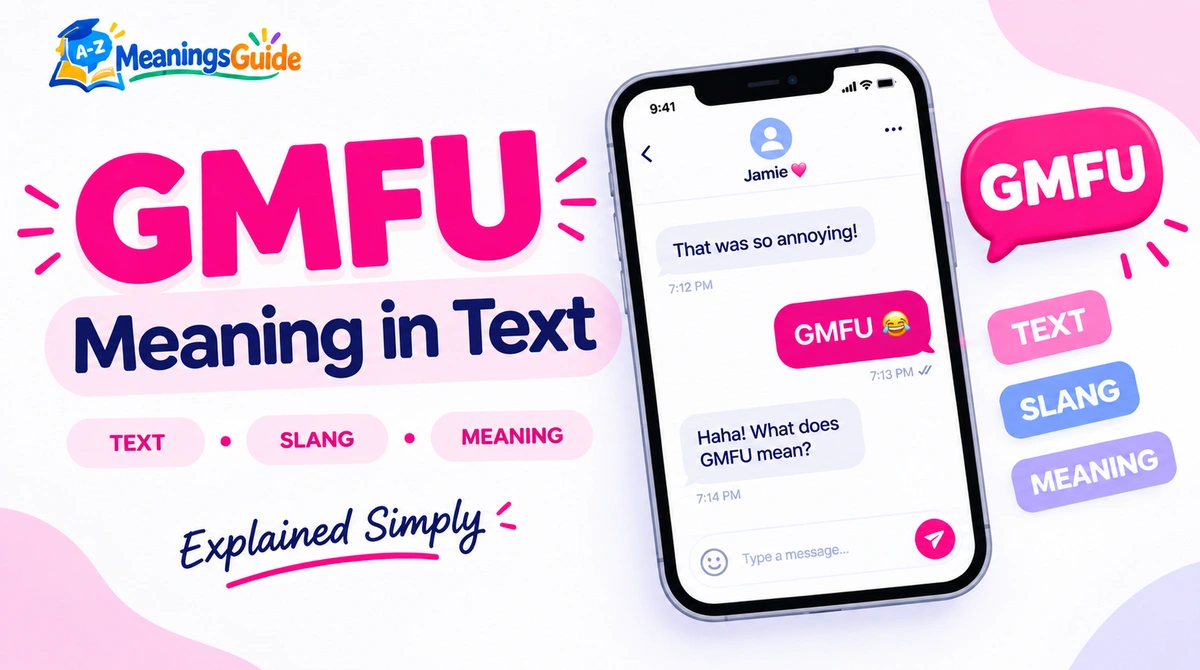
If someone sends you “gmfu” in a text, comment, or DM, you may wonder what they are trying to say. It can look confusing at first, especially if you are not used to short internet slang.
The term gmfu meaning in text usually refers to a phrase used to show strong disbelief, frustration, shock, or annoyance. Depending on the conversation, it can also sound playful or joking.
People often search for the meaning because “gmfu” does not explain itself. Unlike simple abbreviations such as “lol” or “idk,” its tone can change based on who says it and what happened before it.
In this guide, you will learn what gmfu means, how people use it, what tone it carries, how to respond, and when you should avoid using it.
You will also see simple examples from texting, social media, dating, gaming, and work chats. By the end, you should be able to understand “gmfu” without guessing what the sender means.
What Does “gmfu meaning in text” Mean in Text?
In text messages, GMFU most commonly means “got me fucked up.” It is used when someone feels that another person has shocked, annoyed, disrespected, confused, or challenged them. Depending on context, it can be serious, sarcastic, playful, or angry. The exact tone comes from the surrounding conversation.
Other interpretations may appear online, but “got me fucked up” is the main slang meaning. Some people write it in lowercase as “gmfu,” while others use uppercase as “GMFU.”
For example:
- “You think I’m paying for that? gmfu” = You must be mistaken.
- “Bro really said that gmfu” = I cannot believe he said that.
- “You got me gmfu” = You have me feeling shocked or annoyed.
Because the phrase contains profanity, it is casual slang rather than formal English.
The Most Common Meanings of “gmfu meaning in text”
1. “Got Me Fucked Up”
This is the most common meaning of GMFU.
Someone may use it when they believe another person has misunderstood them, crossed a line, or made an unreasonable request.
For example:
“You really think I’m going back after that? gmfu.”
Here, the sender is saying that the other person’s expectation is unreasonable.
Another example:
“He thinks I forgot what happened. GMFU.”
The speaker is making it clear that they remember the situation and do not accept the assumption.
2. Strong Disbelief
GMFU can also express disbelief.
The sender may not literally be angry. They may simply be shocked by something that happened.
For example:
“She bought another phone after saying she was broke. gmfu.”
In this case, GMFU works like a reaction to something surprising or hard to believe.
The meaning is close to:
- “You have to be kidding.”
- “No way.”
- “I cannot believe this.”
- “Are you serious?”
The surrounding conversation tells you how serious the reaction is.
3. Feeling Disrespected or Offended
Sometimes GMFU shows that someone feels disrespected.
For example:
“You ignored me all day and now want a favor? gmfu.”
The person feels that the other person’s behavior is unfair.
Here, GMFU has a stronger tone than simple surprise. It suggests that the sender believes someone has crossed a boundary.
4. Playful or Dramatic Reaction
Friends may also use GMFU as a joke.
For example:
“You ate the last slice? gmfu.”
The person may not actually be angry. They could simply be exaggerating their reaction for humor.
This is common in casual texting, social media comments, and group chats. Friends often use strong slang to make ordinary situations sound more dramatic.
The relationship between the people matters. A phrase that sounds funny between close friends could sound aggressive when sent to a stranger.
How “gmfu meaning in text” Is Used in Real Conversations
Friends & Casual Texting
Friends commonly use GMFU when reacting to something unexpected, annoying, or funny.
For example:
“You went without me? gmfu.”
This could mean, “I cannot believe you went without me.”
Another example:
“You really finished the whole pizza? gmfu.”
The phrase may be playful rather than genuinely angry.
In close friendships, the tone is often easy to understand because both people already know each other’s sense of humor.
However, GMFU can become serious when the conversation involves an argument, insult, broken promise, or major disagreement.
Compare these two messages:
“You took the last cookie? gmfu lol.”
This sounds playful.
“You lied to me again. gmfu.”
This sounds much more serious.
The words around GMFU help show the intended tone.
Instagram & Snapchat
On Instagram and Snapchat, GMFU may appear in comments, captions, stories, or private messages.
Someone might comment:
“Bro really posted that gmfu.”
This can mean the person is shocked by what was posted.
It can also be used as a reaction to a photo, video, opinion, or unexpected update.
For example:
“You look completely different now gmfu.”
Depending on the relationship, this could be teasing, surprised, or even complimentary.
Social media makes tone harder to read because there is less context. A short comment such as “gmfu” can sound harsher than intended.
If someone uses it with laughing language, joking context, or other friendly comments, it is more likely to be playful.
Dating Apps
GMFU can appear in dating conversations when someone is surprised, frustrated, or joking.
For example:
“You said you don’t like coffee but your profile has five coffee pictures. gmfu.”
This could be playful teasing.
Another example:
“You canceled again? gmfu.”
Here, the meaning is more serious. The sender may be frustrated about repeated cancellations.
In dating chats, context matters even more because people may not know each other well. Strong slang can easily be misunderstood.
If you are still getting to know someone, a clearer phrase may work better than GMFU.
Gaming & Online Communities
Gamers and online communities often use short slang to react quickly.
GMFU may appear after a surprising play, loss, argument, or unexpected decision.
For example:
“You sold the whole match at the end. gmfu.”
A player may be jokingly frustrated.
Another example:
“They banned my account? gmfu.”
Here, the phrase shows stronger frustration.
Gaming conversations often move quickly, so abbreviations such as GMFU save time. The slang can also help players express emotion without writing a full sentence.
Still, the phrase contains profanity, so it may not be appropriate in every gaming community.
Work or Professional Chat
GMFU is generally not suitable for professional communication.
A coworker might understand the slang, but that does not mean it belongs in an email, formal message, client conversation, or workplace announcement.
For example, instead of writing:
“This deadline is tomorrow? gmfu.”
A professional alternative would be:
“I was not expecting the deadline to be this soon. Could we discuss the timeline?”
The second version communicates the same frustration without slang or profanity.
In casual workplace chats among close coworkers, someone may use GMFU jokingly. Even then, it is better to consider the workplace culture and who can see the message.
Is “gmfu meaning in text” Rude, Flirty, or Offensive?
GMFU can be rude, but it is not automatically rude in every conversation.
Its tone depends heavily on context, relationship, and the event being discussed.
When GMFU Sounds Rude
It can sound rude when someone uses it during an argument or disagreement.
For example:
“You expect me to believe that? gmfu.”
This can sound dismissive or confrontational.
It may also feel insulting when directed at someone who does not know the slang.
When GMFU Sounds Playful
Close friends may use GMFU as exaggerated humor.
For example:
“You ate my fries? gmfu.”
If both people regularly joke this way, the message may not be serious at all.
The same sentence between strangers could sound much harsher.
Can GMFU Be Flirty?
GMFU is not normally a romantic or flirty abbreviation by itself.
However, flirting can include teasing, and GMFU may appear inside playful teasing.
For example:
“You really think that outfit looks better than mine? gmfu.”
The person could be joking with someone they like.
The flirty meaning does not come from GMFU itself. It comes from the broader conversation and relationship.
Can GMFU Be Offensive?
Yes, it can be offensive because the full phrase contains profanity.
Whether someone finds it offensive depends on their personal preferences, age, culture, relationship, and the setting.
If you do not know the person well, using a cleaner phrase is safer.
How to Respond When Someone Says “gmfu meaning in text”
Your response should depend on the tone of the original message.
Casual Replies
If the person is clearly joking, you can respond casually.
Examples:
- “What did I do?”
- “Lmao, relax.”
- “I’m just saying.”
- “You know I’m right.”
- “My bad.”
- “Okay okay.”
These work well with friends and people you already know.
Funny Replies
If the conversation is playful, you can match the energy.
Examples:
- “And I meant every word.”
- “You heard me.”
- “Stay mad.”
- “I said what I said.”
- “Don’t blame me.”
- “You’ll survive.”
Use these only when you are confident that the other person is joking.
Neutral Replies
If you are unsure about their tone, keep your response calm.
Examples:
- “What do you mean?”
- “Did I misunderstand something?”
- “Are you serious?”
- “Why do you say that?”
- “What happened?”
These replies give the other person a chance to explain.
Professional Replies
If GMFU appears in a work conversation, avoid matching the slang.
Instead, respond to the actual issue.
For example:
“I understand. Let’s figure out what changed.”
Or:
“Could you clarify what part of the plan caused the issue?”
This keeps the conversation professional.
Common Misunderstandings About “gmfu meaning in text”
Assuming It Always Means Anger
GMFU does not always mean that someone is furious.
It can show surprise, disbelief, teasing, annoyance, or frustration.
Look at the entire message instead of treating the abbreviation as a fixed emotional signal.
Thinking It Is Always an Insult
GMFU can sound insulting, but friends may use it as harmless exaggeration.
For example:
“You ate without me? gmfu.”
That does not necessarily mean the sender is genuinely upset.
Confusing It With Other Abbreviations
Internet slang contains many similar-looking abbreviations.
People may confuse GMFU with other expressions because the letters are not obvious without knowing the phrase behind them.
The safest approach is to check the surrounding sentence.
Assuming Capital Letters Change the Meaning
“GMFU” and “gmfu” usually have the same meaning.
Capital letters may simply reflect someone’s typing style.
However, writing “GMFU!!!” may make the reaction feel stronger because of the punctuation and presentation.
Taking Every Slang Message Literally
Internet conversations often use exaggeration.
A person saying “gmfu” may not literally be describing their emotional state. They may simply be reacting strongly for effect.
Context is more important than the abbreviation alone.
Similar Slang Terms You Should Know
Here are some related internet slang terms you may see in similar conversations:
- WTF — A strong reaction to something surprising, confusing, or frustrating.
- FR — Short for “for real,” often used to show agreement.
- IDK — “I don’t know.”
- LMFAO — A strong way to say something is extremely funny.
- SMH — “Shaking my head,” often showing disappointment or disbelief.
- ISTG — “I swear to God,” often used to emphasize a statement.
- ONG — “On God,” used to stress that someone is being serious or truthful.
- WYD — “What you doing?” or “What are you doing?”
- NGL — “Not gonna lie,” used before an honest opinion.
- TBH — “To be honest.”
- BRUH — A reaction to something surprising, ridiculous, annoying, or funny.
- FRFR — “For real, for real,” used for extra emphasis.
These terms can also change tone depending on the conversation.
When You Should Avoid Using “gmfu meaning in text”
Professional Settings
Avoid GMFU in formal emails, job applications, customer messages, business documents, and other professional communication.
The phrase contains profanity and can make a message appear too casual.
Use clear language instead.
For example, say:
“I am surprised by this change.”
rather than:
“GMFU.”
Cross-Cultural Chats
Not everyone understands English internet slang.
Even people who speak English may not know what GMFU means.
If you are speaking with someone from a different language or cultural background, clear wording can prevent confusion.
Instead of relying on slang, explain your reaction directly.
Sensitive Situations
Avoid GMFU when discussing serious personal problems, grief, conflict, health concerns, financial issues, or other sensitive subjects.
A strong slang reaction can make a serious conversation feel less respectful.
For example, if someone tells you they are going through a difficult situation, a response such as “gmfu” may sound dismissive even if you did not mean it that way.
Use straightforward and supportive language instead.
With People You Do Not Know Well
If you are talking to a new friend, customer, teacher, manager, or stranger, it is better to avoid slang until you understand their communication style.
Slang works best when both people understand the same language and tone.
FAQs
What does GMFU mean in text?
GMFU most commonly means “got me fucked up.” It is used to show disbelief, frustration, annoyance, shock, or a feeling that someone is being unreasonable.
Is GMFU a bad word?
GMFU contains profanity, so it is considered casual and somewhat vulgar slang. It is usually better suited to informal conversations than professional or formal settings.
What does GMFU mean on Snapchat?
On Snapchat, GMFU usually has the same meaning: “got me fucked up.” It may express surprise, annoyance, disbelief, or playful frustration depending on the conversation.
What does GMFU mean on Instagram?
On Instagram, GMFU is commonly used as a reaction to a post, comment, story, or message. It can mean “got me fucked up” and may be serious or joking.
Is GMFU rude?
It can be rude because it contains profanity and can sound confrontational. Between close friends, however, it may simply be playful slang.
Can GMFU be used in a flirty way?
Yes, but GMFU is not naturally a flirty term. Someone may use it while teasing a romantic interest, but the flirty tone comes from the overall conversation rather than the abbreviation itself.
What should I reply when someone says GMFU?
If they are joking, you can reply casually or humorously. If you are unsure, ask what they mean or what happened. In a professional setting, respond clearly without using slang.
Final Thoughts.
GMFU is a common piece of internet slang that usually means “got me fucked up.” People use it to express disbelief, frustration, annoyance, shock, or playful disbelief.
The important thing is that GMFU does not always carry the same emotional strength. A friend may use it as a joke after you eat their fries, while someone in an argument may use it to show genuine frustration.
Pay attention to the words around it, the relationship between the people, and what happened before the message. Those details usually reveal the intended tone.
Because GMFU contains profanity, it is best kept for informal conversations where you know the audience understands that style of slang. Avoid it in professional, formal, or sensitive situations.
Understanding slang is less about memorizing abbreviations and more about reading context. Once you know that, messages like “gmfu” become much easier to understand.

Evelyn Hartwell is a content writer and language enthusiast who creates clear, easy-to-understand explanations of English words and phrases. She enjoys helping readers build vocabulary and understand everyday language with confidence.