A friend sends you a plan: “Game night at my place, eight o’clock, you in?” You type back one short word you half remember from pirate films: “aye.” Later that day, another friend drops a party photo in the group chat, and three people reply “aye!” at once — and this time it does not look like a plain yes at all.
If this small word has ever left you unsure, you are not alone. Many people search for the aye meaning in text because AYE is one of the oldest pieces of slang in English, and it has picked up a few layers on its long trip from Scotland and old sailing ships to modern phone chats.
In this guide, you will learn what AYE means, how to tell a calm yes from a happy cheer, and the best ways to reply. By the end, “aye” will feel clear every time it lands in your chat.
What Does “AYE” Mean in Text?
In texting, AYE means yes. People type it to agree, to confirm a plan, or to show they are in. It is an old word for yes that is still used every day in Scotland and the north of England, and sailors made it famous with the reply “aye aye, captain.”
This meaning is fully settled. Dictionaries all give the same answer: Cambridge calls aye another word for “yes,” used most in Scotland and the north of England, and texting guides list it the same way. What changes is the energy. A soft “aye” is a calm yes. A loud “aye!” is a cheer — closer to “hell yes, let’s go.”
The Most Common Meanings of “AYE”

AYE does one main job — it says yes — but people lean on it in a few clear ways. Here is each real use, with the signs that show which one it is.
“Yes” — The Plain Answer
This is the core use, and the oldest one. In Scotland, parts of Wales, Northern Ireland, and the north of England, “aye” is simply the normal word for yes, used the way others use “yeah.”
Examples:
- “Are you coming to lunch?” — “Aye, give me five minutes.”
- “Did you lock the door?” — “Aye, I did it on my way out.”
Signs it is this use: the message before it is a plain yes-or-no question, and the chat stays calm.
“Yes” — Simple Agreement
AYE also works as a warm way to agree with a point. When a friend says something you fully back, “aye” acts like a nod: “true, I am with you.”
Examples:
- “That test was way too hard.” — “Aye, no one finished it.”
- “We should leave early to beat the traffic.” — “Aye, good call.”
Signs it is this use: the message before it is an opinion or a plan, not a question. People often add a word after it — “aye, true” — to keep it warm.
“Aye Aye” — Heard, Understood, and On It
On ships, a single “aye” answers a question, but “aye aye” answers an order. It means three things at once: I heard it, I understand it, and I will do it now. Sailors have used it for hundreds of years. In chats today, friends copy it as a joke reply to a playful order — “got it, on it.”
Examples:
- “Grab snacks on your way home.” — “Aye aye, captain.”
- Captain: “Raise the sail.” — Sailor: “Aye aye, sir!”
Signs it is this use: the word comes doubled, often with “captain” or “sir” after it, and the mood is playful or respectful.
“Aye!” — The Happy Cheer
In modern chats, music, and short videos, “aye!” often works as a cheer: “yes, let’s go!” Rappers use “aye” as a hype sound in songs, and fans picked it up online. Stretched out as “ayyy,” it gets louder and happier.
Examples:
- “We got the tickets!” — “Aye! Let’s go!”
- “Your team won the final.” — “Ayyyy, I knew it!”
Signs it is this use: it comes with an exclamation mark or extra letters, right after good news, a song, or a win. It is not answering a question — it is pure joy.
“Aye” — The Vote for Yes
In parliaments and formal votes, an “aye” is a spoken yes vote. When the yes side wins, the chair says “the ayes have it.” This is not slang, but it is a real use you will meet in news and films.
Examples:
- “All in favour of the plan, say aye.” — “Aye.”
- “The ayes have it — the motion passes.”
Signs it is this use: there is a vote or a meeting, and people answer in a group. The opposite vote is “nay,” which means no.
A Quick Honest Note
A few extra claims float around online, so here is the honest part. Some slang list pages say “aye” at the start of a message can mean “hey” or “yo,” to grab attention — as in “aye, look at this.” Dictionaries do not list this as a set meaning, so treat it as a loose habit, not a rule. There is also a much older word spelled the same way, “aye” meaning “always,” found in old poems — nothing to do with texting. And any list that claims AYE is a secret code or acronym is guessing.
How “AYE” Is Used in Real Conversations
The core meaning stays yes everywhere, but the feel shifts from app to app. Here is AYE in the places you chat most.
Friends & Casual Texting
Between friends, AYE is playful and quick. It confirms plans, agrees with takes, and adds a bit of pirate charm to a plain yes: “Movie at nine?” — “Aye.” Give a friend a mock order and you will get the joke reply back: “aye aye, captain.”
Example chat:
- Friend 1: “Bring the cards tonight, okay?”
- Friend 2: “Aye aye, captain. And you bring the snacks.”
With close friends, the word almost never lands wrong.
Instagram & Snapchat
On Instagram and Snapchat, “aye” shows up in comments, captions, and story replies. Under a win post, “aye!” works as a cheer: “Aye, you did it!” In DMs it is often the short yes to a plan: “Slide by at seven?” — “Aye.” The cheer form is the one you will see most here — often stretched, like “ayyy.” A flat “aye.” can look oddly serious on these fast apps, so most people add a word to keep it warm.
Dating Apps
On dating apps, AYE can add charm — it feels warm, playful, and a bit different from a plain “yeah.” Agreeing with a match — “First dates are awkward.” — “Aye, so awkward” — can feel in sync and fun.
One warning: do not answer everything with one bare “aye.” Early in a chat it can look lazy, like a bare “k.” Pair it with real words — a joke, a question — and it adds flavour instead of ending the talk.
Example chat:
- Match: “Beach trips beat city trips, always.”
- You: “Aye, fully agree. Which beach is your favourite?”
Gaming & Online Communities
Gamers love short, fast words, and “aye” fits team chats well. It confirms a plan in one quick beat: “Push left on my mark.” — “Aye.” When a team lands a big play, the chat fills with the cheer form: “aye!” and “ayyy” work like a crowd roar.
Example chat:
- Player 1: “We hold this point, no one rushes.”
- Player 2: “Aye aye. Ready when you are.”
In gaming spaces, “aye aye, captain” is also a running joke for the team leader’s calls — “order heard, order followed.”
Work or Professional Chat
AYE rarely belongs at work. It is casual and playful, and to a boss or client it can read as a joke when you did not mean one — or confuse a reader who has never used it. “Aye aye, captain” to a manager can sound cheeky, like mockery.
Example of what not to send:
- Boss: “Please send the report by 3 pm.”
- You: “Aye aye, captain.”
Write “Yes, I will send it by 3” instead. The one work place “aye” is normal is a formal vote, where it is the correct word for yes.
Is “AYE” Rude, Flirty, or Offensive?
AYE is not rude in its main uses. It is a plain, friendly yes — the text form of a nod. Most people read it as warm and easy, like “yeah” said in a calm voice.
When it feels positive: AYE feels good when it carries energy — “aye!” after good news, “aye, great idea” in a plan, or a stretched “ayyy” under a friend’s win. It tells the other person you are glad and fully in.
When it feels negative: tone is where AYE can slip. A flat “aye.” after a long, excited message can feel short, like you barely cared. And “aye aye, captain” to the wrong person — a parent mid-argument, a strict teacher — can sound mocking. The word is kind; the moment decides.
Is AYE flirty? Not by itself. It holds no romance in its letters. But its playful charm can feel cute in a chat with a crush — the spark comes from the whole talk, not these three letters.
Is AYE offensive? No. There is nothing bad in the word. It is a normal yes in whole regions of the UK and Ireland, a proud naval word, and a happy cheer online.
How to Respond When Someone Says “AYE”
Most of the time, AYE is already an answer — a yes, an agreement, or a cheer — so it needs no big reply. When you want to respond, match the energy: if it was a calm yes, carry on with the plan; if it was a cheer, cheer back.
Casual Replies
- “Great, see you at eight then.”
- “Perfect, we are set.”
- “Cool, glad you are in.”
Funny Replies
- “Aye aye, captain. Snacks are on you, though.”
- “Spoken like a true sailor.”
- “Aye received and logged, sailor.”
Neutral Replies
- “Okay, thanks.”
- “Got it.”
- “Sounds good.”
Professional Replies
If “aye” ever shows up in a work-adjacent chat, keep your own reply full and clear:
- “Thank you. I will confirm the time in writing.”
- “Perfect, let us lock the plan for Friday.”
- “Understood. I will send the update today.”
If the “aye” felt like a cheer, match the joy instead: “I know, right? Best news all week!”
Common Misunderstandings About “AYE”
People mix up AYE and EYE. They sound exactly the same — both are said like “eye” — but “eye” is the body part you see with, and “aye” is the word for yes. In speech you can only tell them apart from the sense of the talk; in text, the spelling tells you at once.
People think AYE is only pirate talk. Pirates in films do say it a lot — but real sailors used it first, and people in Scotland and the north of England still use it as their normal daily yes. For many people it is just home speech.
People think “aye” and “aye aye” mean the same thing. They are close, but not twins. One “aye” answers a question: yes. Two — “aye aye” — answer an order: I heard it, I understand it, and I will do it.
People read the cheer “aye!” as a plain yes. When a friend drops “aye!” or “ayyy” after good news, they are not answering a question — they are cheering, like “let’s go!” Match the energy back instead.
People think AYE is short for something. It is not an acronym. AYE is a whole, old word, in use for yes since the 1500s. Lists that spell it out as initials are making it up — treat them as guesses, not facts.
People mix up AYE and AY. They look alike, but “ay” on its own is most often a cry of pain or surprise in some languages — like “ay!” when you stub a toe. The yes word is spelled AYE, with the E.
Similar Slang Terms You Should Know
- YEAH — the most common casual yes in chats; soft and friendly.
- YEP — a short, firm yes; a bit more final than yeah.
- YUH — a playful, stretched spelling of yeah, full of energy.
- YEA — an older short form of yes, also used in formal votes.
- NAY — the opposite of aye in votes; a spoken no.
- AYYY — the stretched cheer form of aye; pure hype and joy.
- AHOY — a sailor’s hello; used as a fun greeting in chats.
- FS — For Sure; a sure yes or strong agreement.
- FR — For Real; used to agree strongly or to ask “really?”
- KK — Okay; a soft, friendly way to agree in texts.
When You Should Avoid Using “AYE”
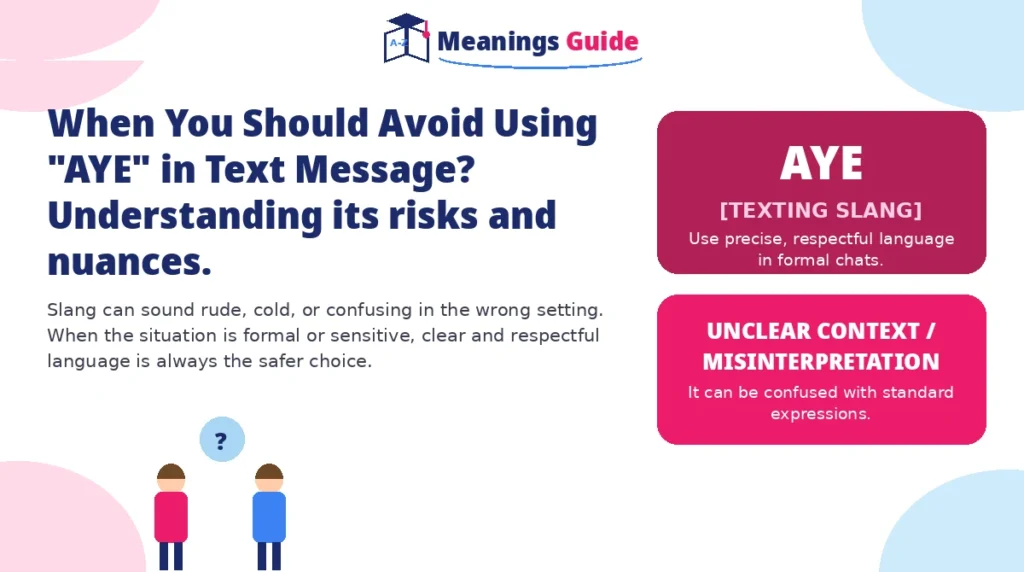
AYE is fine with people who know your tone, but there are clear times to leave it out and use a plain yes instead.
Professional Settings
Do not use AYE in work emails, job applications, client chats, or talks with a boss or a teacher — outside of a formal vote. It is casual and playful, and “aye aye, captain” to a manager can sound like mockery. Write “Yes, I agree” or “Yes, I will do it” in full.
Cross-Cultural Chats
AYE does not travel as well as yes. A friend new to English may read it as “eye” and get lost, and outside Scotland, northern England, and naval or voting settings, many people know it only from pirate films — so it can land as a joke when you meant a plain answer. With new contacts, plain “yes” is clear to everyone.
Sensitive Situations
If someone is sad, stressed, or sharing hard news, a bare “aye” is too small and too playful. It can look like you are turning the moment into a joke. Answer with full, warm sentences: “Yes, I hear you,” “I am here,” “Tell me more.” Save the cheer for light, happy chats.
FAQs
What does AYE mean in texting?
In texting, AYE means yes. People type it to agree, to confirm a plan, or to show they are in. It is the everyday word for yes in Scotland and the north of England, and as “aye!” it also works as a happy cheer.
How do you say AYE?
AYE is said exactly like the word “eye” — rhymes with “my” and “sky.” That is why people mix it up with “eye” in speech. In text, remember: aye with an E is the yes word.
What does “aye aye, captain” mean?
It is the sailor’s reply to an order: I heard it, I understand it, and I will do it now. In chats today, friends use it as a joke reply to a playful order — “got it, on it.”
Is AYE the same as yes?
Yes — in its main use, AYE is simply another word for yes. The difference is flavour: yes is plain and fits everywhere, while aye feels warmer, older, and more playful, with roots in Scottish speech and life at sea.
Why do Scottish people say aye?
Because in Scotland, aye is not slang at all — it is the normal word for yes, passed down through hundreds of years of Scots speech. People there grow up saying it the way others grow up saying “yeah.”
Is AYE rude?
No, not by itself. AYE is a friendly yes, and a normal word for millions of people. It only lands wrong when the tone is off — a flat “aye.” after a heartfelt message can feel cold, and “aye aye, captain” to a strict boss can sound like mockery.
Can I use AYE at work?
It is better not to, apart from formal votes where “aye” is the correct word for a yes vote. In emails and work chats, aye can read as a joke or confuse readers. Write “Yes” in full to stay clear.
Final Thoughts
AYE is a small word with a long life: a simple yes. It is the daily word for yes in Scotland and the north of England, the sailor’s promise in “aye aye, captain,” the yes vote in parliaments, and a happy “let’s go” cheer in modern chats. All of them mean yes at heart.
Now you can read AYE with ease wherever it lands. If a friend sends a calm “aye,” take it as a plain yes and carry on. If it arrives as “ayyy!” after good news, cheer right back. Use it with people who know your tone, write a full yes at work and in tender moments, and your chats will stay clear and kind.

Evelyn Hartwell is a content writer and language enthusiast who creates clear, easy-to-understand explanations of English words and phrases. She enjoys helping readers build vocabulary and understand everyday language with confidence.