Your friend is planning the picnic and sends one long list: “I will bring bread, cheese, juice, fruit ect.” You read it twice. Ect? Is that a new short word you missed? A code for something? You almost reply and ask, but you do not want to look silly over three small letters.
If that moment feels familiar, you are not alone. Many people search for the ect meaning in text because “ect” looks like texting slang, but it is not slang at all. It is one of the most common spelling slips in English: the writer meant “etc.” and flipped two letters. Once you see the trick behind it, you will never mix the two up again — and you will know the one serious case where ECT really is a real term.
In this guide, you will learn what people mean when they type “ect,” why the mistake happens so often, how to spot the medical meaning, and how to reply without sounding rude. By the end, “ect” will never slow you down again.
What Does “ECT” Mean in Text?
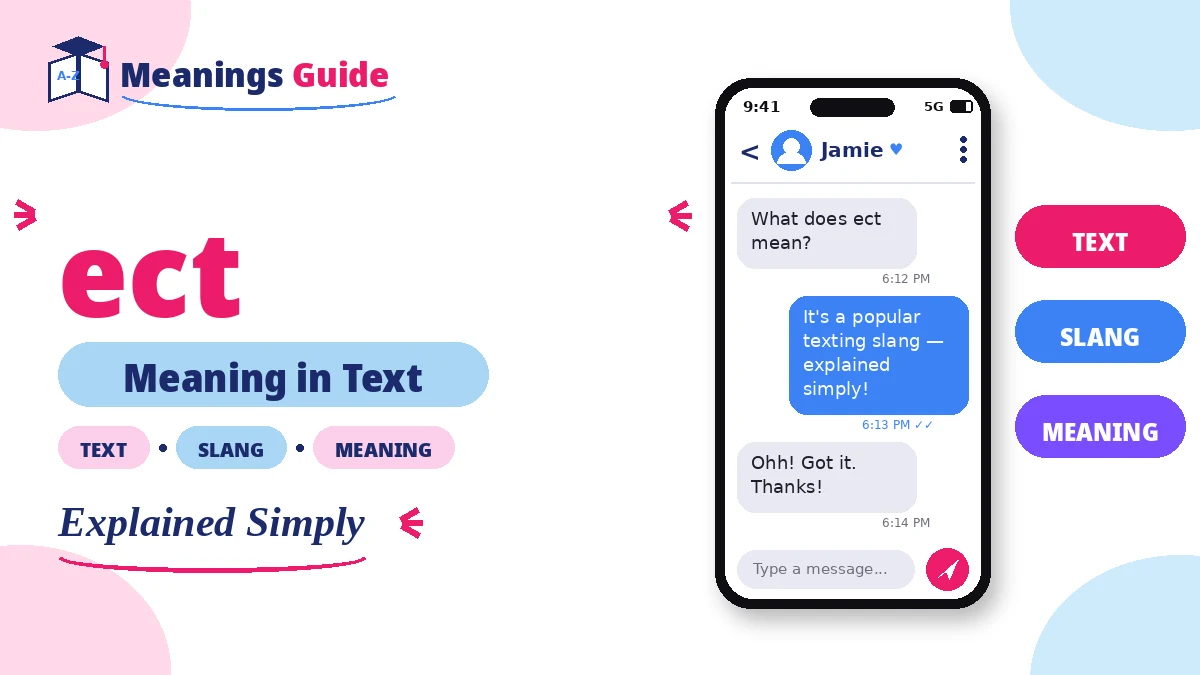
In texting, ECT almost always means etc. typed wrong — the short form of the Latin words et cetera, meaning “and so on” or “and the rest.” People write “ect” at the end of a list when they mean that more items could follow, but the letters are flipped by mistake.
So the short answer is simple: “ect” is not its own word. Every major dictionary and style guide gives the same verdict — the correct form is “etc.,” with the t before the c, and it always ends with a period. In all capitals, in health talk, ECT is also a real medical term: electroconvulsive therapy. Acronym list pages pin many other long forms on the letters, but none are used in normal chats. In a normal text, read “ect” as “etc.” said fast and spelled wrong.
The Most Common Meanings of “ECT”

ECT does not work like normal slang with many meanings. It has one main story — a famous typo — plus one serious medical use. Here is each real case, with its signs.
“Ect” — The List Typo That Means “And So On”
This is the case you will see almost every time. A person writes a short list, wants to say “and more like these,” and types “ect” at the end. They mean “etc.” — the idea is right, only the spelling is wrong. The two middle letters are swapped.
Examples:
- “For the trip we need towels, snacks, sunscreen ect.”
- “He fixed the sink, the door, the lights ect in one day.”
Signs it is this use: “ect” comes right after a list of two or more things of the same kind, and the sentence still makes full sense if you read it as “and so on.”
“Ect” — A Slip Caused by How the Word Sounds
This is the same typo, but it is worth its own space because it explains why smart people make it again and again. Many people say “et cetera” with a hard “k” sound near the front — “ek-set-ruh.” When the sound in your head starts with the “k,” your fingers write the c first: “ect.” Fast typing makes it worse, and spellcheck often lets it pass, because “ect” hides inside real words like “elect” and “affect.”
Examples:
- “She said it out loud as ‘ek-set-ruh’ and typed ‘ect’ without thinking.”
- “Typed in a rush: ‘bring pens, paper, clips ect’ — the sound won over the spelling.”
Signs it is this use: the writer is typing fast or writing the way they speak, and the rest of the message is casual. It is a sound slip, not a knowledge gap — most people who type “ect” know the idea perfectly well.
ECT in All Capitals — Electroconvulsive Therapy
There is one place where ECT is a real, correct term: medicine. In capital letters, ECT stands for electroconvulsive therapy, a medical treatment used for severe depression and some other serious mental health conditions, when other treatments have not worked. Doctors and health sites use this short form in reports and patient information.
Examples:
- “The hospital team talked about ECT as a next step in his treatment.”
- “Her doctor gave her a leaflet that explains how ECT works.”
Signs it is this use: the letters are all in capitals, and the talk is about health, doctors, hospitals, or treatment. This meaning never appears at the end of a shopping list — context keeps the two worlds fully apart.
A Quick Honest Note
Acronym list pages pin dozens of other full forms on ECT — long names from tech, business, schools, and transport. Those lists are built by guessing what the letters could stand for, and the forms almost never show up in real writing. No dictionary lists “ect” as a word, and no slang guide gives it a chat meaning of its own. So treat every other expansion as unproven for texting. In a chat, “ect” is a typo of “etc.” — and in a hospital, ECT is a treatment.
How “ECT” Is Used in Real Conversations
The typo shows up everywhere people write fast. Here is how it looks in the places you chat most.
Friends & Casual Texting
Between friends, “ect” is just background noise. A friend types a fast list — “we watched movies, played games, ordered pizza ect” — and nobody stops the chat to fix it. Everyone reads it as “etc.” and moves on. In close chats the slip is normal and harmless.
Example chat:
- Friend 1: “Packing done: shirts, shoes, charger ect.”
- Friend 2: “Do not forget the tickets this time lol.”
With close friends, nobody keeps score over two flipped letters.
Instagram & Snapchat
On Instagram and Snapchat, “ect” pops up in captions, comments, and quick story text: “best day ever — beach, food, music ect.” These apps reward speed, so small spelling slips are everywhere and readers slide right past them. Because posts here can reach strangers, a careful writer may fix “ect” in a caption before posting — two seconds in the edit box keeps the post looking clean.
Dating Apps
On dating apps, spelling carries a little more weight, because first impressions are all a new match has. A single “ect” will not ruin anything — most people will not even notice it. But a profile full of small slips can make a careful reader think the writer is careless.
Example chat:
- Match: “I love hiking, cooking, old films ect.”
- You: “Old films? Same. What is your favorite one?”
The smart move is to answer the person, not the typo. If your own profile has “ect” in it, swap it to “etc.” — small polish, real effect.
Gaming & Online Communities
Gamers type at full speed, and “ect” is common in game chats and Discord lists: “need wood, stone, iron ect for the base.” Nobody in a match has time to spell-check, and the meaning is clear from the list around it. Online forums are a bit stricter: in guide posts and wiki pages, other users often edit “ect” to “etc.” to keep the shared text tidy — not to shame the writer.
Work or Professional Chat
Work is where the typo matters most. In an email, a report, or a client message, “ect” stands out as a clear spelling error and can make careful work look rushed. Spellcheck may not save you, since the slip can hide from it. One slow read before you send is the real fix.
Example of what not to send:
- You to a client: “We will deliver the files, the report, the slides ect by Friday.”
Write “We will deliver the files, the report, the slides, etc. by Friday” — or better, finish the list in full. At work, the full list is often clearer than any short form.
Is “ECT” Rude, Flirty, or Offensive?
The typo itself is not rude at all. “Ect” is a spelling slip, nothing more. It carries no bad meaning, no insult, and no hidden tone. Most readers miss it or read straight past it as “etc.”
When it feels fine: between friends, in fast chats, and in casual posts, “ect” feels like nothing at all. It is the written form of a small stumble in speech — normal, human, and quickly forgotten.
When it feels negative: the risk is not in typing “ect,” it is in how people react to it. Correcting a friend’s spelling in front of a group can feel smug and picky, even when you mean to help. And in formal writing, the slip can make the writer look careless to a strict reader — a teacher, a boss, or a client.
Is “ect” flirty? No. There is nothing romantic in a flipped-letter typo. Between friends, family, and strangers alike, it is just “etc.” spelled by sound.
Is “ect” offensive? The texting typo, no. But the medical term needs care. ECT the treatment is part of real people’s health care, and jokes about it can hurt people who have had it or who love someone who has. Keep the typo light; treat the therapy with respect.
How to Respond When Someone Says “ECT”
Most of the time, “ect” needs no special reply at all — you just answer the message as if it said “etc.” But if the spelling itself comes up in the talk, here are safe replies for each mood.
Casual Replies
- “Got it — and the rest too, I am ready.”
- “Same list for me, plus extra snacks.”
- “Say less, I will bring my part.”
Funny Replies
- “Ect? The rare cousin of etc. — I know him well.”
- “The ‘ek-set-ruh’ spelling strikes again.”
- “Your list and its mystery ending — I respect it.”
Neutral Replies
- “Noted, thanks.”
- “Okay, sounds good.”
- “Got the list, see you there.”
Professional Replies
If “ect” shows up in a work message, never flag the spelling in front of others. Reply to the task, and if the text must be fixed for a client or a report, fix it quietly in the shared file:
- “Thank you. I will prepare all the listed items, and the rest as needed.”
- “Confirmed. The full list will be ready by Friday.”
- “Understood. I will send the final version in writing.”
If a friend asks you directly how to spell it, one kind line is enough: “It is etc. — think of ‘et’ first, like in ‘et cetera.'”
Common Misunderstandings About “ECT”
People think “ect” is slang with its own meaning. It is not. Unlike real slang, “ect” was never given a meaning by any group of users. It is a spelling mistake that spread because the word sounds like it starts with a “k.”
People think “ect” and “etc.” are both correct, like two spellings of one word. They are not equal. Every dictionary and style guide accepts only “etc.” The letters follow the Latin: “et” means “and,” and “cetera” means “the rest.” Flip the letters and the link to the Latin breaks.
People write “and etc.” and think it sounds fuller. It says the same thing twice. The “et” in “et cetera” already means “and,” so “and etc.” reads as “and and the rest.” Use “etc.” on its own.
People think fixing the typo out loud makes them look smart. In a group chat, a public correction often does the opposite — it reads as picky and can embarrass the writer over a two-letter slip everyone understood. Help once, kindly, in private, or not at all.
People mix up the chat typo with the medical term. They share letters, nothing more. The typo is lowercase, sits after a list, and means “and so on.” The therapy is all capitals, lives in health talk, and names a real treatment. The setting tells you which one you are reading, every time.
People blame autocorrect for every “ect.” Phones do swap letters now and then, but the deeper cause is sound: many people say “ek-set-ruh,” and their fingers follow their ears. That is why the same writer spells “etc.” right in a slow email and wrong in a fast chat.
Similar Slang Terms You Should Know
- ETC. — Et Cetera; the correct form of “ect,” meaning “and so on” at the end of a list.
- E.G. — For Example; used before giving one or two sample items.
- I.E. — That Is; used to restate an idea in clearer words.
- ET AL. — And Others; used at the end of a list of people, often in books and studies.
- AKA — Also Known As; gives another name for a person or thing.
- ASAP — As Soon As Possible; asks for something to happen fast.
- FYI — For Your Information; shares a fact the reader may want to know.
- BTW — By The Way; adds a side point to a chat.
- VS. — Versus; used when two people, teams, or ideas are set against each other.
- APPROX. — Approximately; means “about” or “near,” for numbers and times.
When You Should Avoid Using “ECT”
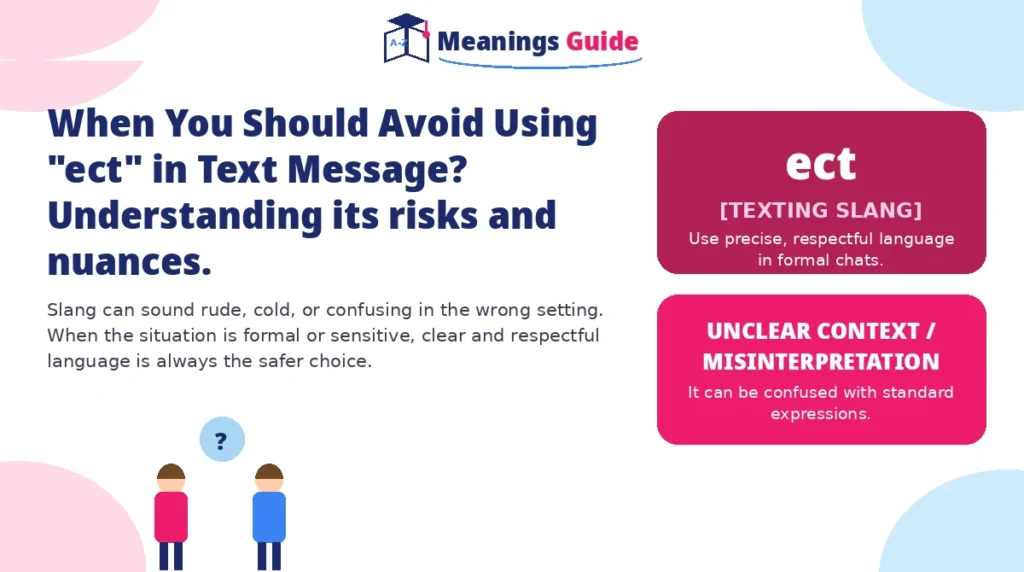
You should not use “ect” at all — the goal is to write “etc.” — but some settings punish the slip far more than others.
Professional Settings
Keep “ect” out of work emails, reports, essays, job applications, and anything a client will read. There, it is not a cute slip; it is a spelling error that can make good work look rushed. If you must shorten a list, write “etc.” with its period — or finish the list in full, which is often clearer anyway. One slow proofread before sending is the best guard.
Cross-Cultural Chats
When you write to someone who is learning English, a visible mistake like “ect” can teach the wrong spelling — they may copy it, trusting your English. Readers from other languages may also search for “ect” as if it were a real word. With new learners or mixed groups, use clean forms: “etc.” — or plain words like “and more.”
Sensitive Situations
Two spots need care. First, if a friend is sharing real health news and the letters ECT appear, they mean the therapy — read with respect, and never joke about the chat typo there. Second, if someone you know struggles with spelling, never tease them about an “ect” in their message. Answer the person, not the letters.
FAQs
What does ECT mean in texting?
In texting, “ect” is a common misspelling of “etc.” It means the same thing the writer meant: “and so on” or “and the rest,” at the end of a list. It is not slang and has no meaning of its own.
Is it ect or etc.?
It is always “etc.” The short form comes from the Latin “et cetera” — “et” means “and,” “cetera” means “the rest” — so the t comes before the c. “Ect” is never correct in English writing.
Why do so many people write “ect” by mistake?
Because of sound. Many people say “et cetera” as “ek-set-ruh,” with a hard “k” sound near the front, so the c feels like it comes first. Fast typing adds to it, and spellcheck misses it.
What does etc. actually mean?
“Etc.” is short for the Latin phrase “et cetera,” which means “and the rest” or “and other similar things.” You place it after two or more items of the same kind to show the list could go on: “pens, pencils, books, etc.”
What does ECT mean in medical talk?
In capital letters, ECT means electroconvulsive therapy — a medical treatment for severe depression and some other serious conditions, used when other treatments have not helped. It belongs to health care and has nothing to do with lists or texting.
Is “ect” a real word or a slang term?
No. “Ect” is not a real English word, not an official short form, and not slang. Dictionaries do not list it. It survives only as a very common typo of “etc.” that almost every reader still understands.
Should I correct someone who types “ect”?
Only if it truly helps — for example, in a shared work file, or when the person asked you to check their writing. In casual chats, let it pass or mention it once, gently and in private.
Final Thoughts.
“ECT” in a chat is a small mystery with a kind answer: it is “etc.” spelled by sound. The writer meant “and so on,” flipped two letters, and the message still made sense. Now you know the fix — “et” comes first, like in “et cetera.” You also know the one case where the letters are real and serious: ECT, the medical treatment, in health talk.
So read “ect” with ease wherever it lands. Answer the list, not the letters. Write “etc.” in your own texts, take one slow look before you send anything formal, and be gentle with other people’s slips. Small kindness, clear writing — that is smart texting.

Evelyn Hartwell is a content writer and language enthusiast who creates clear, easy-to-understand explanations of English words and phrases. She enjoys helping readers build vocabulary and understand everyday language with confidence.