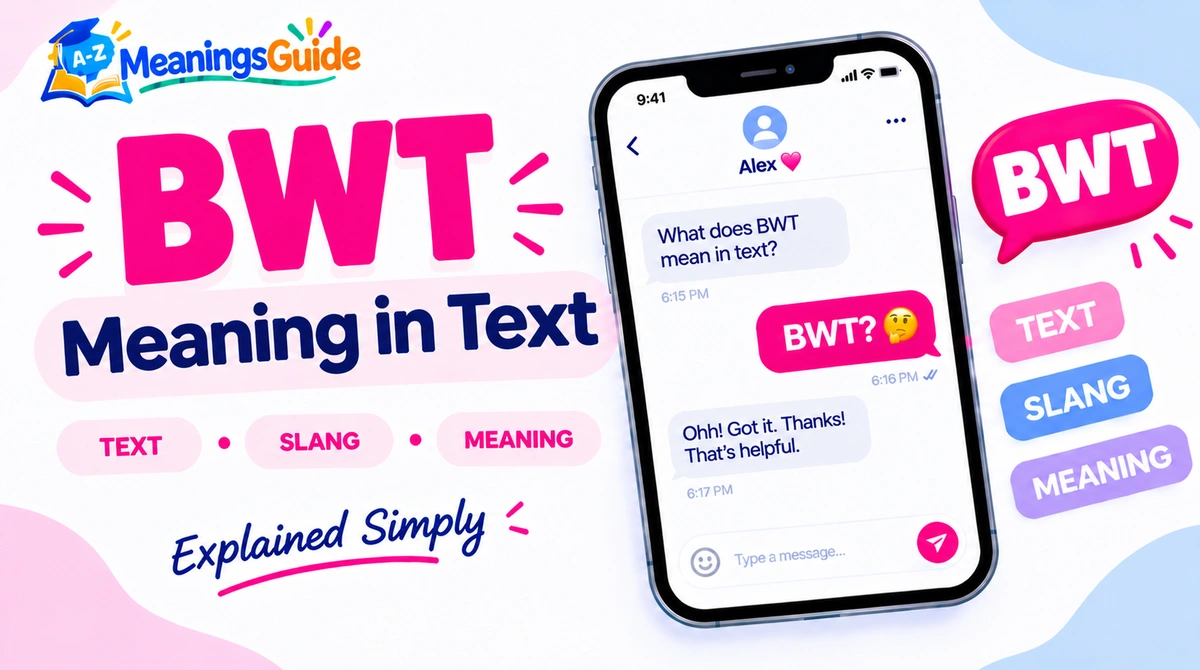
If someone sends you a message like “bwt, are you coming tonight?” you may stop and wonder what they mean. Is it a new slang word? Did they make a typo? Or does BWT have a meaning you have never seen before?
This is why people search for bwt meaning in text. Short forms can be hard to understand because people often type quickly, leave out letters, or create their own shortcuts. BWT is a good example. In everyday texting, it is often understood as a variation or typo of BTW, meaning “by the way.” Some people also use BWT for phrases such as “by the way though” or, in other slang lists, “but when though.”
The good news is that you usually do not need to overthink it. The words around BWT normally show what the sender means.
In this guide, you will learn the common meanings of BWT, how it works in texts and social media, how its tone can change, how to reply, and when you should avoid using it. By the end, you should be able to understand BWT without guessing.
What Does “BWT Meaning in Text” Mean?
In casual texting, BWT usually means “by the way,” often as a typo or informal variation of “BTW.” It is used to add another thought, mention something someone almost forgot, or move to a related topic. Depending on context, BWT may also mean “by the way though” or another less common phrase.
The Most Common Meanings of “BWT”
BWT does not have one universal meaning in every conversation. The context matters. Here are the meanings you are most likely to encounter.
1. BWT = By the Way
This is the easiest meaning to understand.
Many people use BWT when they mean “by the way.” In many cases, it is simply a letter mix-up involving the much more familiar abbreviation BTW.
For example:
“BWT, did you finish the homework?”
The natural reading is:
“By the way, did you finish the homework?”
Here, BWT introduces a new thought.
It can also appear after a main statement:
“I’m going home now. BWT, your jacket is still here.”
The sender is simply adding another piece of information.
Because BTW is far more established, BWT may sometimes be an accidental typo rather than a deliberate slang term. If the rest of the message makes sense with “by the way,” that is usually the safest interpretation.
2. BWT = By the Way, Though
Some people use BWT as a shortened form of “by the way though.”
This version has a slightly different feel. The word “though” can add contrast, a side comment, or a casual change in direction.
For example:
“I don’t think I’ll go tonight. BWT, I really like that place.”
Here, the sender adds another thought that is connected to the previous conversation.
Another example:
“That movie was okay. BWT, the ending was crazy.”
The exact wording is informal, so the meaning depends heavily on the sentence.
This use is less universal than BTW. If the sentence does not clearly support “by the way though,” do not force that meaning onto it.
3. BWT = But When Though
Another meaning found in some texting and slang references is “but when though.”
This can be used when someone wants a more specific time or date.
For example:
“You said we should meet this week.”
“BWT?”
In that context, the person may be asking, “But when though?”
Another example could be:
“Let’s hang out soon.”
“BWT?”
The response is asking for a specific time.
This meaning is much more dependent on context. If the conversation is about plans, dates, schedules, or timing, this interpretation becomes more possible.
4. BWT as a Simple Typo
Sometimes BWT has no special slang meaning at all.
The sender may simply have meant BTW and typed the letters in the wrong order.
This is especially likely when:
- The message already makes sense with “by the way.”
- The person normally uses BTW.
- The message was typed very quickly.
- BWT appears only once.
- Nothing else suggests a special slang meaning.
For example:
“BWT I forgot to tell you something.”
It is reasonable to read this as:
“BTW, I forgot to tell you something.”
You do not need to ask what BWT means every time you see it.
How to Tell Which Meaning Is Intended
Look at the sentence before and after BWT.
If someone says:
“BWT, I bought your favorite snack.”
“By the way” makes sense.
If someone says:
“Okay, we can meet Saturday.”
“BWT?”
“But when though?” may make more sense.
If the message feels like an ordinary casual transition, the sender may simply be using BWT as a form of BTW.
The key rule is simple: read the whole message, not just the three letters.
How “BWT” Is Used in Real Conversations
BWT is mainly suited to informal digital communication. Its meaning and tone can change slightly depending on where you see it.
Friends & Casual Texting
Friends may use BWT while adding a quick thought to a conversation.
For example:
“I’m already home. BWT, your keys are with me.”
Or:
“BWT, are we still going out tomorrow?”
In these messages, BWT helps the writer move into another point without making the conversation feel formal.
It can also appear in very short messages:
“BWT, you free later?”
The person probably means:
“By the way, are you free later?”
When chatting with close friends, spelling and grammar are often less important. People may leave words lowercase, remove punctuation, or use unusual abbreviations.
Instagram & Snapchat
On Instagram and Snapchat, people often write quickly in DMs, Story replies, and casual conversations.
You might see:
“BWT your new pic looks good.”
Or:
“BWT did you see my story?”
In this setting, BWT is usually informal. The sender is not trying to write perfect English. They are simply keeping the conversation moving.
If BWT appears in a comment, the surrounding comment is especially important because short social media messages can have multiple interpretations.
Dating Apps
BWT can also appear in dating conversations.
For example:
“Your profile made me laugh. BWT, what part of town are you from?”
Here, “by the way” is a natural reading.
A person might also write:
“Okay, dinner sounds good. BWT, what time?”
Again, the abbreviation simply helps introduce another question.
Do not assume that BWT itself is a romantic signal. The abbreviation does not automatically mean someone is flirting.
The tone comes from the entire conversation.
For example:
“BWT, you look really good in that picture.”
That message may sound flirty because of the compliment, not because of BWT.
Gaming & Online Communities
Gamers and online communities often use short forms because messages need to be quick.
Someone might write:
“BWT, the server resets at midnight.”
Or:
“BWT, who’s joining the next match?”
In a fast-moving group chat, BWT can work as a quick transition between topics.
However, gaming communities also create their own abbreviations. If BWT appears alongside game-specific terms, check the surrounding message before deciding what it means.
Work or Professional Chat
This is where you should be more careful.
You might understand BWT as “by the way,” but it is not a standard professional abbreviation.
For example, sending:
“BWT, I finished the report.”
to a manager may look like a typo or overly casual shorthand.
A clearer version is:
“By the way, I finished the report.”
Or:
“Also, I finished the report.”
In professional communication, clarity is more useful than saving two or three characters.
Is “BWT” Rude, Flirty, or Offensive?
BWT is not normally rude, flirty, or offensive by itself.
Its tone depends on the sentence, relationship, and situation.
When BWT Feels Friendly
It can sound friendly when someone adds a small personal detail.
For example:
“BWT, I saved you a seat.”
That feels casual and helpful.
When BWT Feels Playful
A person may use BWT before adding a joke or unexpected comment.
For example:
“BWT, I definitely did not eat the last slice.”
The humor comes from the sentence, not the abbreviation itself.
When BWT Can Feel Cold
Almost any short abbreviation can feel cold if the overall message is short or blunt.
For example:
“BWT. You forgot again.”
The issue here is not the letters BWT. The rest of the message creates the negative tone.
When BWT Can Appear Flirty
BWT can appear inside a flirty message, but it does not create the flirting.
For example:
“BWT, you looked really cute today.”
The compliment gives the message a flirty feel.
If someone sends only “BWT,” there is not enough information to decide that they are flirting.
Is BWT Offensive?
There is no common offensive meaning attached to BWT in ordinary texting. Still, abbreviations can have different meanings in different communities, industries, or private groups.
If you are unsure, look at the full sentence or ask what the person meant.
How to Respond When Someone Says “BWT”
Your response depends on what the sender is trying to say.
Casual Replies
If BWT means “by the way,” simply respond to the new information.
Them: “BWT, are you free tonight?”
You: “Yeah, I think so. What’s up?”
Another example:
Them: “BWT, I still have your book.”
You: “Oh yeah! I’ll get it tomorrow.”
You do not need to mention the abbreviation.
Funny Replies
If the conversation is playful, you can answer with humor.
Them: “BWT, I ate your fries.”
You: “That was a crime.”
Or:
Them: “BWT, I have something to tell you.”
You: “Now you have my attention.”
The goal is to respond to the actual message rather than focus too much on the abbreviation.
Neutral Replies
If you are unsure what BWT means, ask directly.
You can say:
“What do you mean by BWT?”
Or:
“Do you mean BTW?”
This is better than guessing when the message could have more than one meaning.
Professional Replies
If BWT appears in a work chat, focus on the information after it.
For example:
Them: “BWT, the meeting moved to 3.”
You: “Thanks for letting me know.”
If the abbreviation creates confusion, you can ask for clarification without making a big deal about it.
Common Misunderstandings About “BWT”
Because BWT is not used in exactly the same way by everyone, several misunderstandings can happen.
Mistaking BWT for an Official Abbreviation
Not every three-letter combination has one fixed definition.
BWT can be interpreted differently depending on the person and context.
Do not assume that a slang website’s definition automatically applies to every conversation.
Assuming It Always Means “By the Way”
“By the way” is a very useful interpretation, especially when BWT appears where BTW would normally fit.
However, context can point toward another meaning.
For example:
“Let’s meet sometime this week.”
“BWT?”
This could reasonably be read as “but when though?” rather than “by the way.”
Thinking BWT Is Always Intentional
Sometimes it is just a typo.
People type quickly. They hit the wrong keys. They swap letters. They send messages before checking them.
If someone normally writes BTW and suddenly types BWT, a simple typo may be the most likely explanation.
Thinking BWT Has a Hidden Romantic Meaning
BWT does not automatically mean someone likes you.
If someone writes:
“BWT, you’re cute.”
the compliment may be romantic.
But:
“BWT, bring your charger.”
is simply a reminder.
The words around the abbreviation matter more than the abbreviation itself.
Confusing BWT With BTW
This is probably the biggest source of confusion.
BTW = By the Way
BWT = often a typo or informal variation of BTW, but it can have other context-based meanings.
If replacing BWT with BTW makes the message completely natural, the sender probably meant “by the way.”
Similar Slang Terms You Should Know
If you are learning texting slang, these abbreviations may appear alongside BWT:
BTW — “By the way.” Used to introduce an extra thought or topic.
TBH — “To be honest.” Used before a personal or direct opinion.
IDK — “I don’t know.” Used when someone is unsure.
IMO — “In my opinion.” Used to introduce a personal view.
FYI — “For your information.” Used to give someone useful information.
NVM — “Never mind.” Used when something is no longer important or needs no answer.
OMG — “Oh my God.” Used to show surprise, excitement, or shock.
LOL — “Laughing out loud.” Often used to show amusement or soften a message.
BRB — “Be right back.” Used when someone is leaving a chat briefly.
IRL — “In real life.” Used to separate online activity from offline life.
LMK — “Let me know.” Used when asking someone to provide an update or answer.
ASAP — “As soon as possible.” Used when something needs quick attention, though it can sound more work-related than casual slang.
When You Should Avoid Using “BWT”

BWT is best kept for informal communication. There are several situations where writing the full phrase is clearer.
Professional Settings
Avoid BWT in formal emails, applications, reports, business proposals, and important work messages.
Instead of:
“BWT, I attached the document.”
write:
“By the way, I attached the document.”
Or simply:
“I also attached the document.”
Clear language makes professional communication easier to understand.
Cross-Cultural Chats
Not everyone understands the same internet slang.
If you are speaking with someone who is learning English, BWT may create unnecessary confusion.
Instead of assuming they know the abbreviation, use:
“By the way…”
This takes only a few extra characters and makes your meaning clear.
Sensitive Situations
Avoid unusual slang when discussing serious topics.
If you are talking about an important problem, an apology, a conflict, or a sensitive personal matter, clear language is usually better.
For example, instead of:
“BWT, we need to talk about yesterday.”
say:
“By the way, I want to talk about what happened yesterday.”
The second version is much easier to understand and less likely to create confusion.
When the Meaning Could Be Misread
If the message has two possible meanings, do not use BWT.
For example, if you are asking someone about an exact time, write the question clearly instead of relying on an abbreviation that could be interpreted differently.
Good texting is not just about being short. It is about being understood.
FAQs
What does BWT mean in text?
BWT most often works as a variation or typo of BTW, meaning “by the way.” Depending on context, some people use it for “by the way though” or “but when though.”
Is BWT the same as BTW?
Not always, but they are often connected. BTW clearly means “by the way,” while BWT may simply be a typo or informal variation. Context tells you whether another meaning is intended.
What does BWT mean from a guy?
There is no special meaning based on whether a guy sends it. In most casual conversations, it can mean “by the way” or be a typo for BTW. Look at the rest of the message to understand his tone.
What does BWT mean from a girl?
It generally has the same meaning regardless of who sends it. BWT may mean “by the way,” “by the way though,” or another context-based phrase. The sender’s gender does not determine the definition.
Is BWT a slang word?
BWT can be used as informal internet shorthand, but it is not as established or widely recognized as common abbreviations such as BTW, LOL, or IDK. It can also simply be a typing mistake.
Does BWT mean “but when though”?
It can. Some slang references use BWT for “but when though,” especially when someone is asking about the timing of a plan. However, that meaning depends on the conversation.
Should I use BWT in a professional message?
Usually, no. BWT can be unclear in professional communication. Writing “by the way,” “also,” or another clear phrase is safer and more professional.
Final Thoughts
The simplest way to understand bwt meaning in text is to look at the surrounding conversation.
In many casual messages, BWT is best understood as “by the way” or as a typo of the much more common BTW. Some people also use it to mean “by the way though,” while other slang references give it meanings such as “but when though.” Because usage is not completely standardized, context matters.
If someone writes:
“BWT, don’t forget your keys.”
you can probably read it as:
“By the way, don’t forget your keys.”
If someone writes:
“Let’s meet this weekend.”
“BWT?”
the context may suggest:
“But when though?”
You do not need to memorize every possible definition. Instead, check the sentence, the topic, and the relationship between you and the sender.
And if the meaning is still unclear, simply ask.
Good texting is not about knowing every abbreviation. It is about understanding what the other person is trying to say and making sure your own message is easy to understand.

Evelyn Hartwell is a content writer and language enthusiast who creates clear, easy-to-understand explanations of English words and phrases. She enjoys helping readers build vocabulary and understand everyday language with confidence.


